A Childhood. Sandra Barnard and Myrna Shoa record their stories. The world through the eyes of children. The stories of first generation immigrant's children born in Cheetham Hill Manchester, England. Their stories may resonate with yours. Sandra and Myrna are artists, teachers and storytellers.

Showing posts with label scotland. Show all posts

Thursday, 1 October 2026

A CHILDHOOD REMEMBERED

DO YOU REMEMBER?
HOW OUR PARENTS MET
Our mother, Ina Hendry, was born in Clydebank, Scotland in 1904, the second youngest of five children. She was the daughter of James and Margaret Hendry (nee Stuart).Her sisters and brothers in order of birth were, Jean, the oldest, who arrived at the very end of the 19th century, then Robert, the second born. He emigrated to the United States as a young man, tried to make a career in show business and then began working in the automotive industry. He settled in Chicago where he married Jeanie. Betty was the third child. She moved to England and married Bert Fay a chef in a London hotel. They adopted Bert’s natural daughter, Cathy. They had no children of their own. The youngest was James. He married Nellie, considered by his family to be socially beneath him. Nellie was a Catholic. They had a large family and lived on a council estate near Loch Lomond. James worked as a master butcher. He died of lung cancer in the late 1950s.

Ina Hendry moved to Manchester when she was nearly 18 and managed a sweet shop. It was here she met our father Joseph Horowitch who fell for her in a big way. He was the second of three surviving children of Meyer and Bella, Jewish Latvian refugees, escaping anti-Semitism and poverty at the turn of the century. They had intended to emigrate to the United States, but somehow, they ended up in Manchester. The family name in Latvia was either Einger or Unger. They acquired the surname Horowitch through a misunderstanding with an immigration officer in Liverpool. (However, on the web we have found a reference to Judel Einger, otherwise known as Joseph Horowitch and our house address in Salford 7 at the time, So, now we know the name was Einger!)).

Myer Horowitch started his own business, buying waste wool, cotton and scrap metal, sorting it and selling it to manufactures, where it was recycled and made into new products. Joseph left school at 14 and went to work for his father. Joseph had contracted Rheumatic fever when a small child. This damaged his heart, which caused his premature death when he was in his fifties.

Ina and Joseph married in 1922. Ina was not welcomed by Joseph’s family. Mixed marriages were considered by both the Jewish and Christian communities as something to be avoided. However, over a period of time, relations improved and Ina converted to orthodox Judaism. She married Joseph in the Synagogue on July 26 1931. She became a Jewish woman, learnt the rituals and festivals. (By the time we were born she had in fact got a Ketubah, a Jewish marriage contract, therefore confirming that we were Jewish).

They wanted children, but it seemed it was not to be. They considered adoption and then after being married for 20 years the miracle happened. Ina was pregnant. Myrna was born in September 1943 and 13 months later a second daughter Sandra was born. Ina named Myrna after Myrna Loy the American film star who was famous for her long beautiful legs.
Ina had become very fat, 16 stone in weight and she didn't even realise that she was pregnant, putting the pains down to heartburn! Maybe Joseph had impotency problems and that is why she never conceived earlier, or maybe he just didn't fancy her as her shape had enlarged considerably over the years.

MYRNA'S MEMORIES
Christmas time ’Mum had Sandra and me peering up the chimney of the coal fire in the breakfast room. Why? We had to ask Father Christmas to get us what we wanted.’
Of course we believed in Father Christmas; leaving a pillowcase out on Christmas Eve for him to fill. Then we discovered the truth. Dad was Father Christmas and not a man with a red hat and coat on with a beard, but Dad, swarthy and handsome even though he was old.

DO YOU REMEMBER?
I can remember when sweets were rationed, rice was only used for making rice pudding, olive oil was bought at Boots the Chemist in little bottles for removing ear wax, spices were limited to cinnamon, nutmeg, pepper and cloves, all vegetables were boiled to death, crisps only came in one flavour, garlic was the work of the devil and everything seemed so bland.

Being brought up in a Jewish household meant that some of the food we ate was more interesting than the usual British diet. Chicken then was a luxury food yet we ate on a regular basis, either made into wonderful chicken soup with mandels or alkies or roasted for Sunday lunch. Mum made the best chopped and fried fish. She always swore that a mix of hake and haddock gave the best and sweetest flavour. This would be chopped with onion, loads of eggs, matzo meal and seasoning then formed into generous patties and fried in oil until deep golden brown. I enjoyed them either hot or cold, served with the beetroot and horseradish relish called chrane. Myrna didn’t like that sauce!

I still hanker after the black bread of my childhood. It doesn’t seem to exist anymore, or at least I can’t find it. This was a crusty sourdough bread made with rye flour and caraway. It was wonderful, as were, and still are, proper Jewish bagels, hard and chewy, nothing like the soft US version sold in most supermarkets today.

We would enjoy salt beef, pickled brisket, worsit and the deep red savaloys served with potato latkes and sweet and sour cucumbers. This was the kosher food of the Ashkenazi Jews of Eastern Europe, hearty, full flavoured and very different from the cuisine of the Sephardi community. We would go to Lapidus's, a local Jewish delicatessen and take away, have a salt beef sandwich at the same time as eyeing up the young men also buying food there.

Wednesday, 2 September 2026

PAST PRESENT AND FUTURE

PAST PRESENT FUTURE

THE PRESENT MEETS THE PAST


In 2021 during the Covid  Pandemic, completely unexpectedly I was contacted by two different people from my (late) sister Sandra's and my past, who knew us, and had found us via social media and the website. I had an email from Richard Casson from Manchester. He had been to the same primary school, Thomas Street. Whilst researching the school he came upon this website!
I had an email from Louise the daughter of Margaret Hendry Bushnell in Scotland saying that her mum is our cousin. I hadn’t  seen or heard from any of the Hendry”s since Sandra and I were about 10 or 11 years old and Margaret about 8 or 9. Our mother took us up to Scotland to visit them.  Margaret’s father was our mothers’s brother James.  I had no idea that she was alive. Margaret for many years had been looking for the Horowitch girls, Myrna and Sandra.
​Since getting in touch we have found out that we share some Horowitch and Hendry stories and photos. I had a photo of Margaret”s family in an album and she had a photo of Sandra and me with our mum wearing a large hat. Margaret's family now know that the stories she had told them about. 
The Toilet Paper Story from Margaret. Sandra and Myrna came to our place in Balloch in the 1950s. The housing block had only one shared outside toilet. We all only used newspaper as toilet paper as it was cheap and readily available but to impress your mum, our mum Nellie bought some Izal hard shiny toilet paper especially for you girls. But the plan went wrong. Your mum was horrified to see that you both had purple backsides. She couldn’t work out why,
Some neighbours seeing the posh medicated paper took it and replaced it with newspaper.
​​After about 63 years my first cousin Margaret speaks to me via Messenger.
​ Here is what she told me.

MARGARET BUSHNELL HENDRY. HER STORIES
"Your mum Ina's dad James lost everything. Also, my father James and mum Nellie lost everything. I think their house was bombed and they had nothing except the clothes they had on. Poverty was a big problem in our lives. James my grandfather had Irish descendants. He had a pawn shop. (Our mum had told  Sandra and me that it was an antique shop) and he lost it all and after his wife Margaret died he took to drink. 'Our mum hated him, as he would kick her', Myrna
Margaret, my cousin tells me another story about aunty Betty or Bessie as they called her. Elizabeth was her full name so both are correct. Only about 20 years ago Margaret was told his story.
"Betty had a child out of wedlock and she gave the child to a relative to look after. The child was sickly and died very young. Betty never ever came to see her child. Then Betty adopted Cathy a daughter from her husband Bill's affair. (The mother of the child didn’t want to keep her and let Bill take their daughter. Betty brought the child up with Bill as though she were hers.  Cathy when an adult also got pregnant out of wedlock and everyone was embarrassed and didn’t want our mum to find out about it.  Cathy was told not to come out and meet our mum. Cathy then was forced to give up her child for adoption. She said that she would’ve loved to have found out what happened to her child Margaret said. Betty never had another child of her own". Margaret.
Then 2 months after Margaret got in touch with me I had an email from Richard Casson, from Cheetham Hill Manchester who knew Sandra and me very well from primary school. He had lived in the same area as us.  While researching Thomas Street School Cheetham Hill Methodist, Richard discovered this site. He is a passionate researcher of family stories and histories and has a record of people from that time who knew us both well. He is still in touch with many from that time.
Through these new encounters I am able to reach back onto the past and add information, my truths to those times which in turn will affect the future for all of us who knew those stories from so long ago.
History is fluid, the way we look at events is dependent on what information is gathered from different points of view, the context of the times.  Memories of past events and stories  will inevitably become fixed if no new input has  been added to those recollections.

NOW IS THE TIME TO FILL IN THE GAPS IN OUR STORIES

Sandra would be delighted to know that finally  we can be heard.

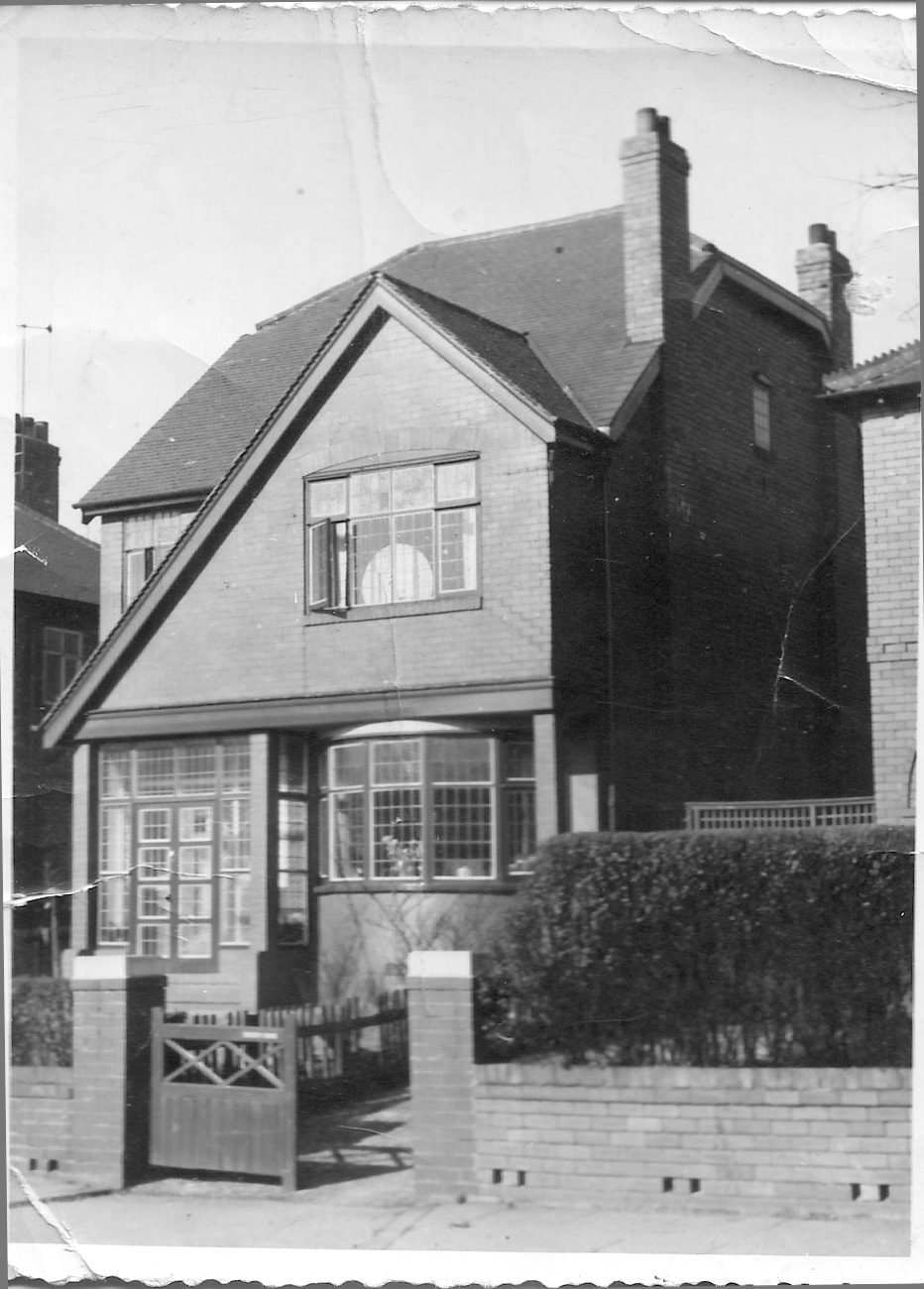
BEHIND THE CLOSED GATE

Susan a childhood friend lived across the road from our house. She wrote about the Horowitch's house, how the gate was always closed (barred) triggered off  thoughts for me about the stories that become like myths of a time.
​Susan "The Horowitch house was conspicuous as the front gates were always closed (effectively a barrier).  If you asked the girls to come and play they always had an excuse why they couldn't.  Their mother was sleeping and they shouldn't disturb her, or they were going elsewhere".
Picture
Sandra and I were part of a cover up about what really went on behind the closed doors of our house. I can now pull off the cover of respectability and reveal the secrets. The moral and cultural framework at the time of our growing up silenced us all.
"Susan as a child herself would have had no idea what madness went on inside the house behind the gate.  Who would have listened at that time to 2 young children talking about their mother?
Sandra and I would come home from school find our mum on the floor completely drunk, ranting incoherently or find her trying to kill herself by leaving the gas poker on unlit. Our mother hated all our friends and would let rip how awful they all were. Even our dad concealed the secret. ” Myrna. 

RESPECTABILITY

 Susan - "We lived in a narrow environment, were not really aware of things  outside our own world.  Todays age of electronic communications  would have been unimaginable then.
We grew up in an era where RESPECTABILITY and MORALITY ruled the day.  Ladies wore hats and gloves, when they went out. When did you last buy a pair of dress gloves to match your shoes?   White shoes could be worn from June, before then it was déclassé.
Times have certainly changed".  
 "It’s fascinating how things change, words take on other meanings, what was important at one time becomes irrelevant at another time. All this is what interests me about looking back at these stories," Myrna.

MORALITY

 Susan  "A major scandal that did become public.  A Rabbi in the community was having an affaire with the wife of a Jewish butcher.  The husband found out and threatened him with a meat cleaver. His aim being to remove the offending equipment.  He was prevented from fulfilling his ambition."

SANDRA ARTIST TALENT 

“I am able to amend the past by telling 'what happened next' therefore the stories in the Past become the Present and the Future will change because of the new information," Myrna. 

 “Sandra’s artistic talent was apparent even at primary school. I always admired her art prowess. She would often draw things for me," Richard. “Sandra was closer in age to me, so we were in the same class. Her artistic talent was apparent even then,” Susan.  Similar comments came via emails from other people from that time.

 Myrna “Yes Sandra was very good at art. As I was a year ahead no one knew about me. Sandra and I both spent time drawing around our home. At Broughton High School for girls encouraged by art teacher Miss Grist, I also became ‘good at art’. Both Sandra and I were encouraged to study art at Manchester Regional College of Art. I completed the course but Sandra decided not to, as she was so upset by our dad's premature death that she felt she didn’t deserve to continue. She was almost 17 year old. From that time I have lived my life through art in, fashion, prints, greetings cards and film. 
Sandra after a divorce returned to complete the art course. Her talent was such that she got accepted on the course simply with an A4 folder of her recent drawings and paintings. Sandra and I over the years shared many creative projects".
FEEDBACK FROM THE PAST TO NOW
RICHARD CASSON’S Thomas Street stories and more
"The Jewish community is so tight. I still retained a core of friends from primary school days (not secondary although one or two of these have crossed my path) and information just seemed to come my way. I suppose most of us as we grow older wonder what might have become of our primary school classmates? Some of the people in the Thomas Street black and white school photographs I just felt very close to as I had played with them as kids and wondered what became of them. Every one has a story to tell. Dear Sandra is in several of my class photos however it was her talent for art that I remembered mostly. I do remember the playroom in your house. I certainly had no inkling of some of the things that have recently been revealed. 
When the Thomas Street ex pupils started to meet up regularly it was always a case of ''I wondered what happened to?" 
Brian - "I remember well the Horowitch girls, particularly Sandra, and even the mother. She was, of course, close with my grandmother Anita, and I remember being invited to parties at their place. I have a picture of Sandra at one of my parties. And I was quite fascinated with the webpage and the openness with which they wrote about the relations with the mother".
Susan - "Myrna and the late Sandra have my admiration and respect on being strong, proud women they became.  The beautifully recorded family history is a tribute to them and their achievements".


Picture